GPT-6.2 migration: prefix edits drop reasoning, and none is rejected
GPT-6.2 migration changes reasoning retention. Check prefix edits, Responses tools, effort settings, cache billing, and misleading completion reports.
9 min readTutorial

Announcements, tutorials, model analysis, and product updates from AIHubMix.
GPT-6.2 migration changes reasoning retention. Check prefix edits, Responses tools, effort settings, cache billing, and misleading completion reports.
GPT-6.2 Astra cuts input/output rates 20% and cache reads 60%. Compare the bill, unchanged limits, and low-effort regressions before upgrading.
Qwen4-Max has the lower ordinary token price. Kimi K3.1 Pro has a different thinking contract. Neither fact tells you which produces an acceptable patch in your repository. Choose by the cost of a change that passes review, then check that your agent's API path preserves the model's required history. The useful comparison is a concrete task: repair a bug across two files, retain public behavior, and pass the existing tests. Give both models the same repository state, tools, instructions, and s
Moving from Qwen3.8-Max to Qwen4-Max changes more than the model ID. Both have a million-token context, but an output limit previously sized for the answer now also pays for thinking. The default effort changes, and agents must preserve reasoning history correctly across tool calls. Start with one Chat Completions request, then one small repository task. Check the answer, stopping reason, history, and resulting diff before moving an existing workflow. Recalculate the output limit The Chat
Qwen4-Max is worth evaluating if you already use Qwen3.8-Max: ordinary input and output prices are 25% lower at Alibaba Cloud's Singapore list rates. The context window stays at one million tokens, and both accept text, images, and video. That makes price the clearest documented reason to try the upgrade. It does not establish that the new model solves your tasks better or uses fewer tokens. The migration also changes an integration contract. An answer-only output cap can now limit thinking an
Use doubao-seedance-2-5-flash with POST /ai/v1/videos, poll the task, then download its result. The current AIHubMix schema exposes 480p/720p output, 4–30-second clips, and up to 10 image, 5 video, and 5 audio references. Older clients using /v1/videos need to change the endpoint as well as the model ID. This guide was checked on November 16, 2026. Both the short ID above and doubao-seedance-2-5-flash-261115 returned a model schema and rejected a 1080p request with 400 schema_violation. A sepa
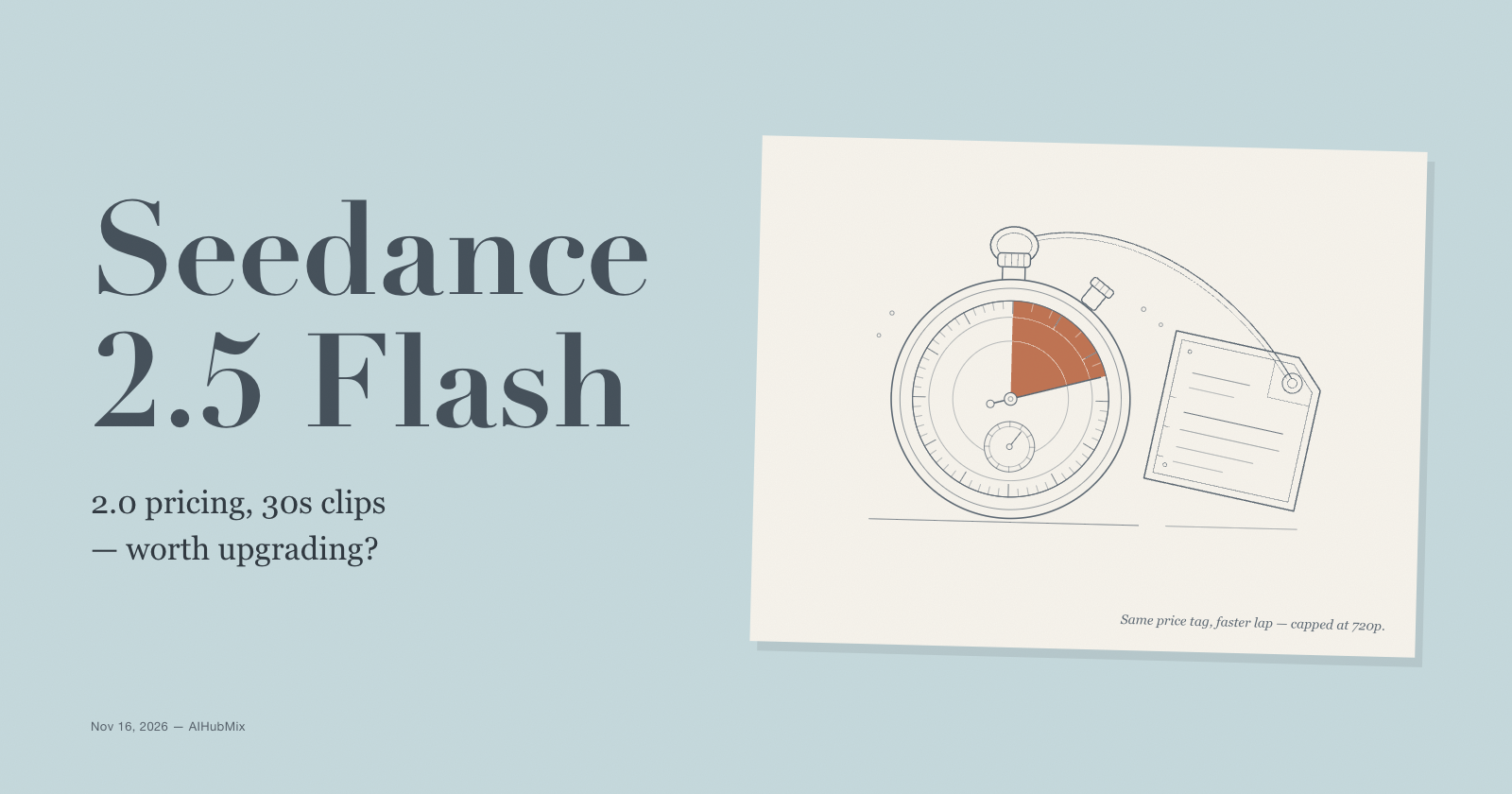
Updated November 16, 2026. Specifications and official prices were checked against live vendor documentation and AIHubMix schemas on this date. It is worth testing if your video pipeline delivers at 480p or 720p. Seedance 2.5 Flash keeps Seedance 2.0's official token rate ($7.00 per million tokens without video input, or $4.30 with video input) while matching Seedance 2.5's 30-second single-shot ceiling. At those resolutions, its official USD rate is 34.6% below Seedance 2.5 without video inpu
The three Gemini 4 models share one 1M-token context window, one long-decode architecture and, on Google's API, one request schema. Switching between them there is a model-string change. What differs is the shape of the quality, cost and latency envelope, and Hydrogen has just moved the default inside that envelope. At its default high setting, Hydrogen scores 51 on Artificial Analysis's Intelligence Index at $1.87 per task and 8.3 minutes. Argon high scores 50 at $4.97 and 30.6 minutes. Hydro
Gemini 4 Hydrogen has four thinking levels, and they behave like four different models. On Artificial Analysis's live measurements, the same model scores 27 at low, 41 at medium, 51 at high and 54 at xhigh. The default is high, and xhigh is new to the Gemini 4 family: Carbon and Argon stop at high. The spread is wide: the same model spans 27 index points from low to xhigh. Moving from medium to high buys 10 index points for about $1.07 more per task. Moving from high to xhigh buys 3 points for
Gemini 4 Hydrogen costs twice as much per token as Gemini 3.8 Flash's introductory rate: $1.50 per million input tokens and $7.50 per million output tokens, against $0.75 and $3.75. On Artificial Analysis's live measurements, Hydrogen completes an index task for $1.87; Gemini 3.8 Flash takes $7.77. The token price doubled, and the cost per completed task fell by about three quarters. That is the unusual part of this upgrade. Google recommends Hydrogen as the upgrade from Gemini 3.8 Flash and e