AIHubMix Blog

Announcements, tutorials, model analysis, and product updates from AIHubMix.

  • Choosing a Reasoning Effort for GPT-6.1 Sol: low to max

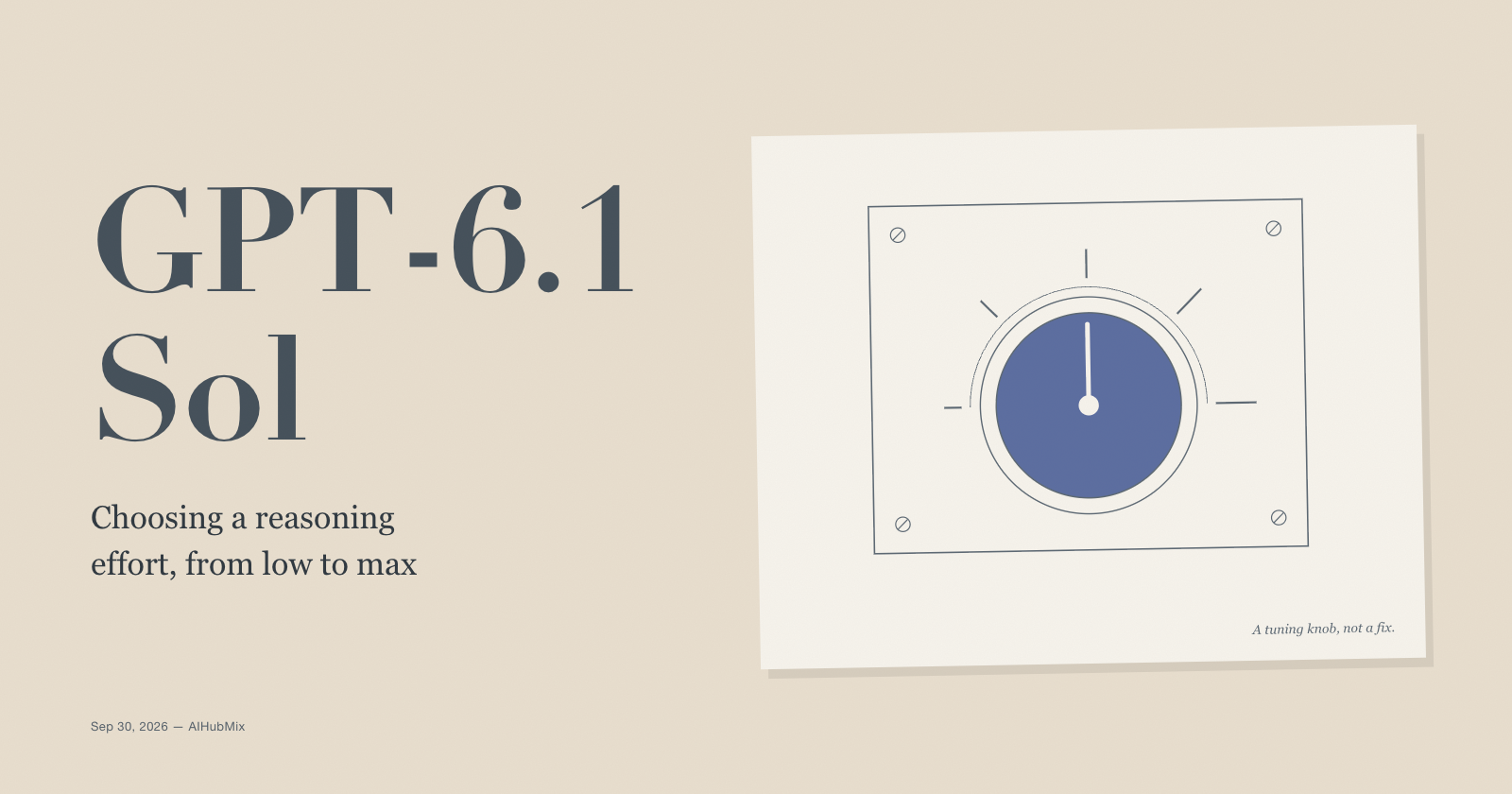
    Choosing a Reasoning Effort for GPT-6.1 Sol: low to max

    GPT-6.1 Sol has five reasoning effort levels: low, medium (the default), high, xhigh, and max. The big change from GPT-6 Sol is that none and minimal are gone, so low is now the floor. This one setting drives both latency and cost. You never see reasoning tokens, but you pay for them at the output rate ($10 per million for 6.1 Sol on AIHubMix), and they take up room in the context window. Pick the wrong level and you can easily pay several times more than you need to. What each level is for

    6 min readTutorial

  • AIHubMix Adds Claude Sonnet 5.5: An Upgrade for Everyday Work at Unchanged Token Prices

    AIHubMix Adds Claude Sonnet 5.5: An Upgrade for Everyday Work at Unchanged Token Prices

    A 1-million-token context window, input at $2 and output at $10 per million tokens, with browser access and a shared gateway to multiple model providers. AIHubMix now offers Claude Sonnet 5.5, Anthropic's latest Sonnet model. Users can access it through AIHubMix Playground or compatible applications for writing, organizing information, preparing presentation content, and other everyday work. Compared with Sonnet 5, Anthropic reports faster output generation, clearer writing, and more efficient

    3 min read
  • Xiaomi MiMo v2.6 Pro Quick Start: Three Steps from Browser to Code

    Xiaomi MiMo v2.6 Pro Quick Start: Three Steps from Browser to Code

    Update (October 23, 2026): mimo-v2.5-pro was retired on 21 October 2026, and AIHubMix no longer accepts requests for it. Use mimo-v2.6-pro, which costs the same. The quick answer: open https://playground.aihubmix.com/ in your browser, type a question, press send. No installing, no coding, and free trial calls without entering a card. Key points * The model is mimo-v2.6-pro, made by Xiaomi, released 22 September 2026 * You can use it in a browser for free before deciding anything * It read

    4 min read
  • How to Use Xiaomi MiMo v2.6 Pro on AIHubMix: Setup Guide

    How to Use Xiaomi MiMo v2.6 Pro on AIHubMix: Setup Guide

    Update (October 23, 2026): mimo-v2.5-pro was retired on 21 October 2026, and AIHubMix no longer accepts requests for it. Use mimo-v2.6-pro, which costs the same. In short: point the official openai Python SDK at https://aihubmix.com/v1, use model ID mimo-v2.6-pro, and authenticate with your AIHubMix key. The API is OpenAI-compatible (callable in the same format as OpenAI's), so no special client is required. Setup takes about five minutes. Key points * OpenAI-compatible API — change base_ur

    7 min read
  • How to Call Jev on AiHubMix: A Structured Classification Tutorial

    How to Call Jev on AiHubMix: A Structured Classification Tutorial

    Short answer: jev-1.13 does not generate text. You POST a piece of text plus a set of named questions to https://aihubmix.com/v1/systemone, and you get back typed answers keyed by your question names — a category, a score, or a probability. Nothing to parse. Below is a working request, the full response format, and the one design mistake that will quietly cost you accuracy. What Jev is for Use it when you need a judgment, not a paragraph: routing a support ticket, scoring severity, flagging u

    5 min read
  • DeepSeek V4.1 Flash API Pricing Compared: AIHubMix vs OpenRouter

    DeepSeek V4.1 Flash API Pricing Compared: AIHubMix vs OpenRouter

    Update (October 23, 2026): AIHubMix’s limited-time 30% discount on DeepSeek V4.1 Flash ended on September 27, 2026. The prices, cost example, and comparison below have been updated to current list prices on both platforms. DeepSeek V4.1 Flash is now available on AIHubMix and OpenRouter. It supports text and image inputs, a 1M-token context window, tool calling, structured outputs, and agent-oriented workflows. On AIHubMix, the lowest-priced routes list DeepSeek V4.1 Flash at $0.1408 per millio

    3 min read
  • Why did Gemini turn Chinese for no reason?

    Why did Gemini turn Chinese for no reason?

    Gemini may occasionally produce Chinese in its reasoning or final response even when you expect English. This usually points to temporary multilingual language drift. It does not, by itself, mean that Gemini has switched to a separate Chinese model. The short version: inspect the full conversation for Chinese language signals, restate the desired output language, and do not use the stream setting as a language fix. What Gemini language drift means Language drift occurs when a model begins in

    3 min read
  • Jev Explained: How to Add Fast, Typed Decisions to an AI Agent

    Jev Explained: How to Add Fast, Typed Decisions to an AI Agent

    Jev is best understood as a decision layer for software. It reads text or structured state and returns predefined classifications, scores, and yes-or-no probabilities. It does not write an answer for the user. That narrower interface makes it relevant to high-volume routing, triage, verification, and guardrail steps inside AI agents. The practical pattern is simple: let Jev make frequent, reversible judgments; let business code enforce policy; escalate uncertain or consequential cases to a capa

    6 min read
  • How to Create an AI Product Ad with Claude Code and AIHubMix

    How to Create an AI Product Ad with Claude Code and AIHubMix

    With one clear product image, Claude Code, and the AIHubMix API, you can generate character references in Seedream, register them as virtual-person assets, and use Seedance to create an AI product ad. This tutorial is based on a real aloe-mist campaign and includes the project structure, configuration, commands, and complete video prompt. The target output is a 20-second, 720p, 9:16 vertical ad with an AI-generated person and setting. Claude Code and AIHubMix power the full workflow. Claude Co

    9 min read